Why 31% of Complex Initiatives Fail to Deliver Full Benefits (And How to Stop the Bleeding)
Most high-stakes corporate projects do not fail in one dramatic event—they bleed out slowly through costly rework, recycled decisions, and invisible trust gaps.
And, they lose momentum gradually. A decision is deferred. A stakeholder concern remains unspoken. A meeting revisits something the team thought had already agreed. Important knowledge sits with one person while everyone else works from slightly different assumptions.
The initiative may still appear viable. The technical solution may be sound. Reports may continue tracking time, cost and scope. Underneath those measures, however, confidence can weaken, knowledge can fragment and organisational energy can be consumed by repetition, uncertainty and rework.
Eventually, the gap between the plan and the lived reality becomes impossible to ignore.
At a glance
- Only half of projects in PMI’s 2025 study fully delivered value exceeding the effort and expense involved.
- Technical planning remains essential, but sponsorship, adoption, evidence, voice and trust influence whether intent becomes action.
- Leaders need earlier visibility of the conditions affecting progress—not simply more reporting after performance has deteriorated.
The performance gap is larger than most organisations realise
Recent research gives leaders reason to look more closely at what happens between a sound plan and a successful outcome.
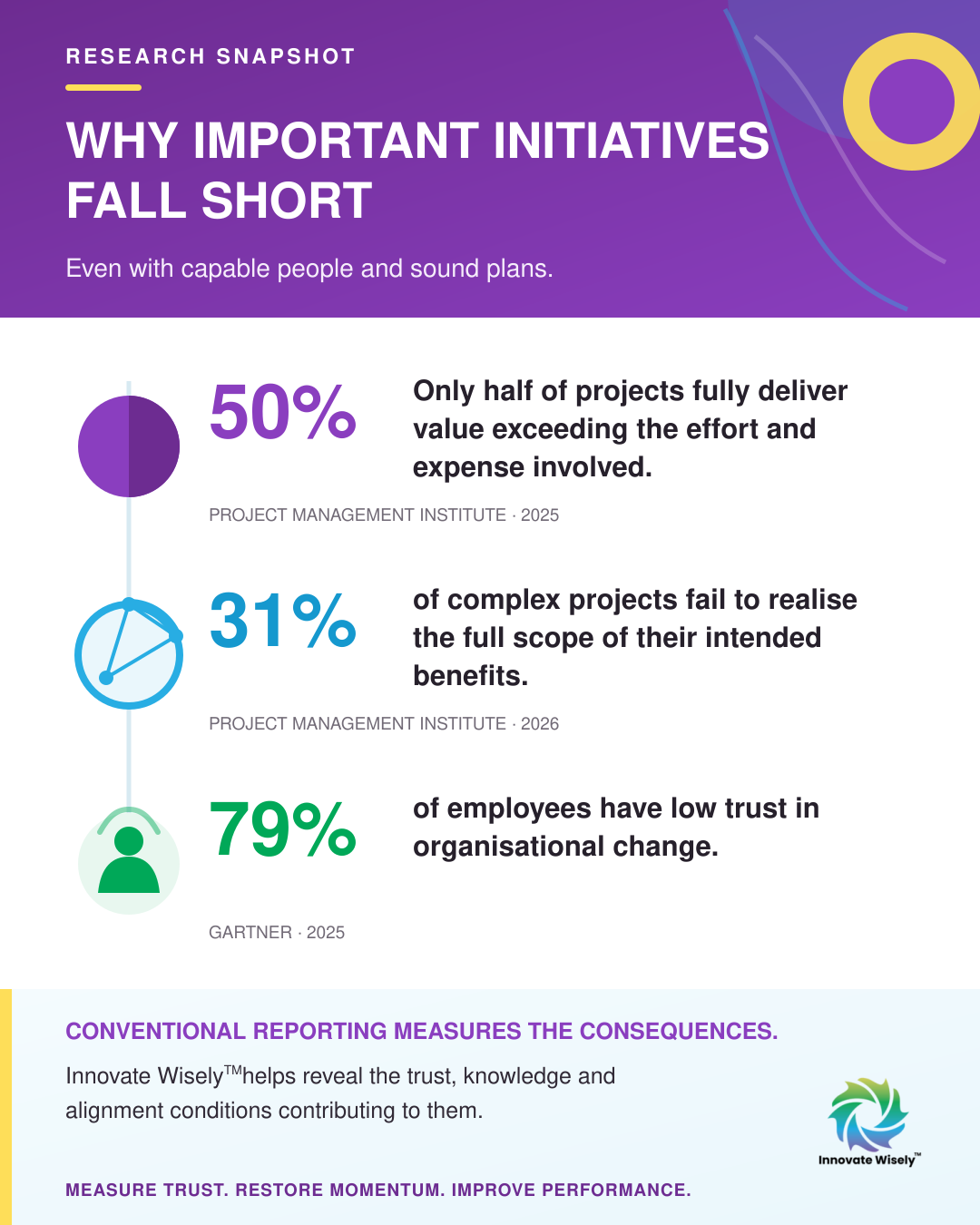
50% Only half of projects fully delivered value exceeding the effort and expense involved. Another 37% partially delivered and 13% failed outright.
Project Management Institute, 2025
35% More senior executives identified the disconnect between planning and execution as the greatest barrier to organisational reinvention than any other factor.
Project Management Institute companion executive survey, 2025
31% Nearly one-third of complex projects failed to achieve the full scope of their intended benefits.
Project Management Institute, 2026
79% Four in five employees had low trust in organisational change; only 32% of leaders reported healthy adoption.
Gartner, 2025
Complex projects involve interconnected systems of people, technology, governance, stakeholders and external pressures. Managing tasks is necessary. Navigating those relationships and dependencies is what allows a technically sound solution to create value.
The evidence also shows what improves the odds
Poor outcomes are not inevitable. Several studies point to practical conditions leaders can influence.
Prosci reports that initiatives with effective change management met or exceeded objectives 88% of the time, compared with 13% where change management was poor. It also reports that 79% of respondents with extremely effective sponsors met their objectives, compared with 27% of those with extremely ineffective sponsors.
Those findings are correlational and come from a commercial change-management provider, so they should not be treated as proof that one methodology caused success. They nevertheless reinforce a useful point: visible sponsorship, deliberate adoption support and attention to the people affected by change matter.
Gallup’s United States employee data found that only 20% strongly agreed they trusted organisational leadership, while 29% strongly agreed their manager actively supported their team during change. The “strongly agree” threshold is demanding, but the result still highlights a substantial leadership-support gap.
In Australia, the OECD found that 52% of people expected government to use the best available evidence in decision-making, while only 46% felt they had a say in what government does. The OECD identifies evidence-based decision-making and meaningful voice as important drivers of trust in public institutions.
Each study uses a different population, definition and research method. The percentages should not be combined into one universal failure rate. Their value lies in the pattern they reveal: strategy, execution, sponsorship, adoption, evidence, voice and trust interact.
A familiar pattern in complex initiatives
Consider a composite example drawn from recurring patterns in technical and infrastructure projects rather than from one identifiable client.
A project team has completed a robust options assessment and selected a technically defensible solution. Workshops have been held and the governance structure appears clear. Yet decisions are repeatedly revisited, operational staff remain cautious and the sponsor believes the project needs more communication.
A closer look reveals several different conditions: stakeholders do not share the same definition of success; critical operational knowledge was not incorporated early enough; people are unsure who owns the adoption decision; and the delivery team is behaving as though the initiative is ready to adopt while other stakeholders are still trying to form confidence in the purpose and evidence.
Another communication campaign would create more activity without necessarily resolving those conditions. A more useful response would revisit the shared purpose, test the evidence and assumptions, bring operational knowledge into the decision, clarify ownership and determine what support people need to move forward.
The technical plan may require little change. The conditions surrounding delivery may require significant attention.
Five early warning signs that momentum is weakening
Decisions keep returning. Issues believed to be settled are repeatedly reopened because confidence or ownership was never secure.
Agreement is not becoming action. People appear supportive in meetings, but commitments are delayed, diluted or quietly resisted afterwards.
More communication is producing little movement. The quantity of information increases without resolving doubts about purpose, evidence, impact or support.
Critical knowledge sits with too few people. Progress depends on individuals, informal history or assumptions that have not been made visible.
Adoption is treated as a downstream task. The technical solution advances while the people expected to use, operate or support it remain outside the decision process.
Conventional reporting measures the consequences
Time, cost, scope and benefit measures remain essential. They are often lag indicators. By the time they show a serious problem, the conditions producing it may have existed for months.
A delayed milestone does not reveal:
- whether stakeholders trust the purpose and expected value;
- whether the knowledge and assumptions informing decisions are considered sufficient and credible;
- whether people trust the proposed approach and those responsible for it;
- whether concerns can be raised safely and early; or
- whether people have the ownership, capacity and support needed to adopt the outcome.
Leaders often respond with more meetings, revised governance, additional reports or another dashboard. Each intervention may have value. None will automatically reveal what people are hesitant to say or why apparent agreement is not translating into action.
Trust is part of the delivery infrastructure
Trust is commonly discussed as a cultural aspiration—something organisations should build because it creates a better workplace. That matters, but it is not the whole story.
Trust also acts as a structural condition affecting whether knowledge moves, risks surface, decisions hold and people participate with sufficient confidence to move an initiative forward.
The relevant question is not simply, “Do people trust each other?” Leaders need to examine whether people trust:
- the purpose and expected value of the initiative;
- the knowledge, evidence and assumptions informing it;
- the proposed approach and decision process;
- the relationships involved in delivery; and
- the organisational support available for implementation and adoption.
Those distinctions turn trust from an abstract sentiment into a condition that can be examined and managed.
Knowledge and energy matter as well
Trust does not operate alone. When knowledge becomes fragmented, teams work from competing versions of reality. They revisit old questions, repeat earlier work and become dependent on a few individuals.
As uncertainty persists, energy dissipates. Capable people spend more time chasing information, defending decisions and navigating organisational friction. Participation declines and momentum becomes harder to restore.
The visible performance problem may therefore be the downstream consequence of three less visible conditions:
Trust: insufficient confidence in the purpose, knowledge, approach, relationships or support.
Knowledge: gaps, contested assumptions, poor transfer or critical insight held by too few people.
Energy: declining willingness and capacity to participate, decide and act.
Three questions to ask before adding another solution
- What do our current reports tell us—and what can they not tell us?
- What might stakeholders believe, know or fear that has not yet surfaced in formal discussions?
- What will another three months of delay cost in time, money, confidence and organisational energy?
The purpose is not to blame people or declare that the organisation has a trust problem. It is to identify the conditions affecting progress early enough to take useful action.
From measurement to practical action
Measurement alone is not the outcome. Leaders need evidence that changes what they do next.
The InnoWise® framework examines an initiative at its actual stage—Form, Create, Adopt or Critique—because the trust, knowledge and support required are different at each point. The Trust Analyser™ helps surface initiative-specific evidence, while the Knowledge Canvas™ helps translate that evidence into shared priorities and action.
The aim is straightforward: identify what is really holding an important initiative back and give leaders a practical basis for restoring momentum before more time, money and confidence are lost.
Is an important initiative not meeting expectations?
A confidential conversation can help determine whether trust, fragmented knowledge or weak alignment is affecting progress—and what to examine next.
Book an Initiative Momentum Conversation: Book a call with Lee
References
Gartner (2025), Healthy Change Adoption
Gallup, Leadership & Management Indicator
OECD (2024), Australia Country Note
OECD (2025), Drivers of Trust in Public Institutions in Australia
PMI (2025), Strategy–Execution Gap